How to Choose the Right Sports Flooring for Your Facility
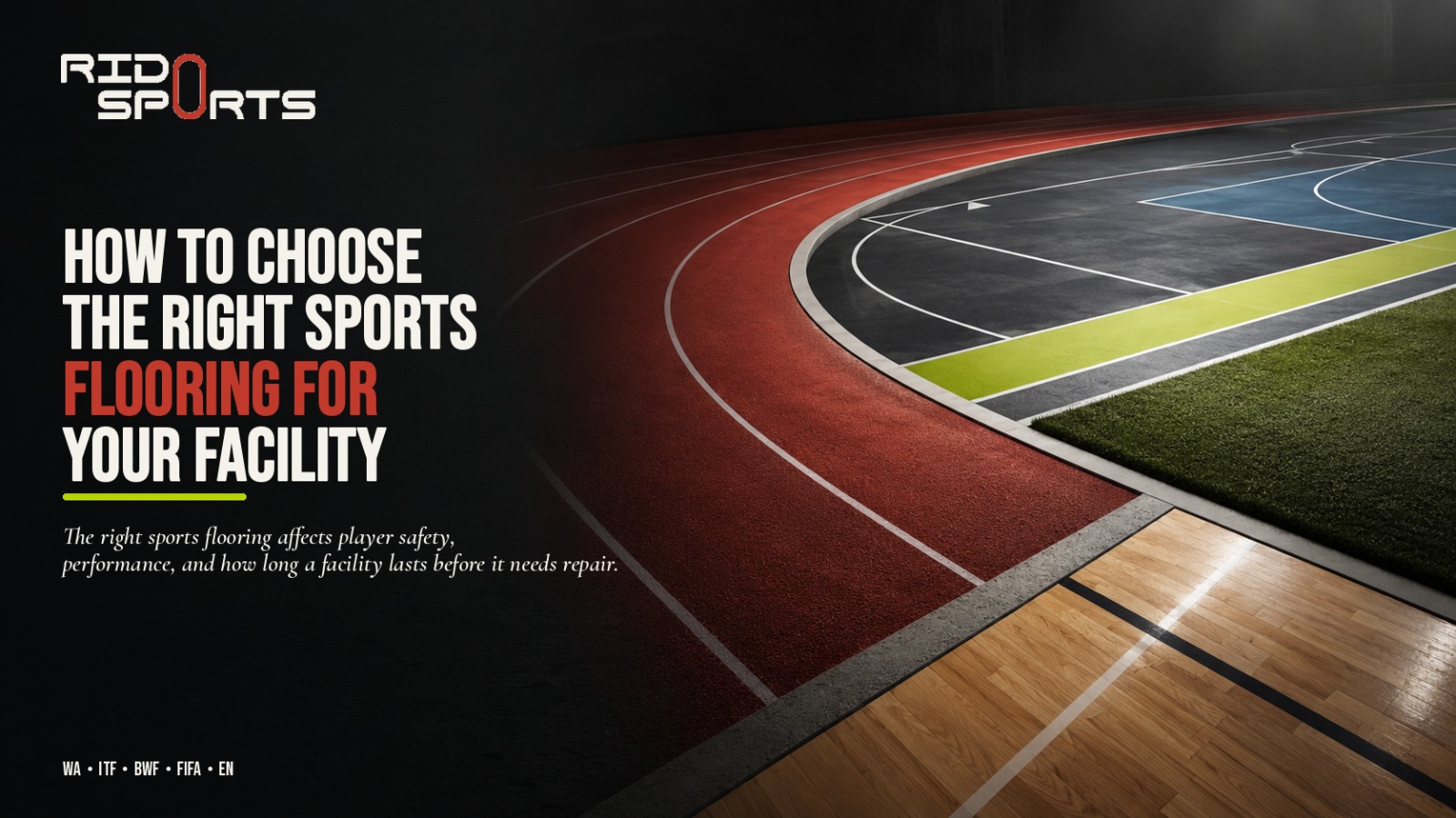
The right sports flooring affects player safety, performance, and how long a facility lasts before it needs repair. A school does not need the same flooring as a stadium. This guide covers what works best for each facility type, based on budget, usage, and long-term plans.
School Playgrounds
Assuring children’s safety is the first priority. Budgets are limited too, so flooring should be durable and low maintenance.
What we recommend:
-
EPDM rubber flooring for play areas: soft, safe, and available in bright colours.
-
A spray-on or sandwich-system track, at a fraction of stadium-grade cost.
-
A basic acrylic court for basketball or badminton, easy to maintain between classes.
RidoSports Tip: Start with a spray-on track and one multi-purpose acrylic court. Both can be upgraded later without rebuilding the base layer.
Universities and Colleges
University facilities see heavy daily use plus inter-college competitions, so flooring needs to be durable and consistent.
What we recommend:
-
A WA-certified Sandwich System track for inter-college meets, cheaper than Full PUR.
-
ITF-classified acrylic courts for tennis and basketball, built for daily student use.
-
Indoor PU or wooden flooring for basketball and badminton halls used year-round.
Residential Societies
Society courts are mainly for recreation, not competitive training. Residents want a court that looks good, is safe for children and walkers, and needs little upkeep.
What we recommend:
-
A multi-purpose acrylic court marked for two sports, such as basketball and badminton, on one surface.
-
EPDM walking and jogging tracks for the society's park or common area.
-
Weather-resistant surfaces, since these courts sit outdoors year-round without regular maintenance.
The priority here isn't performance specs. It's a well-maintained court that stays usable for longer.
Sports Academies
Academies train athletes for competition, so flooring must match real competition conditions, which is why certification matters most here. ITF-classified courts and BWF-approved flooring give students the same bounce and grip they will face in competition, while protecting their joints.
What we recommend:
-
Ridocryl acrylic flooring, ITF Category 3 medium pace, for tennis academies.
-
Ridoflex Pro 9, a BWF-approved surface, for badminton academies.
-
Ridoflex Full PUR, a WA-certified track, for athletics academies.
RidoSports Tip: If students compete at state or national level, confirm your court or track carries the right certification (ITF, BWF, or WA).
Stadiums and Large Complexes
Stadiums face the highest requirements: official tournaments, heavy footfall, and year-round reliability. Certification isn't optional here: without WA, ITF, BWF, or FIFA approval, a venue can't host sanctioned events.
What we recommend:
-
WA-certified Full PUR tracks for a 400m, competition-grade facility.
-
FIFA-preferred artificial turf for football and multi-sport grounds.
-
ITF or BWF-certified courts, depending on the sport hosted.
RidoSports has delivered this level of flooring for government sports departments, defence establishments, and organisations such as BCCI and ONGC.
Indoor vs Outdoor Flooring
Indoor flooring is judged on shock absorption, ball response, and comfort, which is why PU flooring and maple hardwood are common indoor choices.
Outdoor flooring must withstand sun, rain, and temperature swings without cracking or fading. UV-resistant acrylic resin and proper drainage matter as much as the surface itself. Water pooling after rain usually means a base layer problem.
RidoSports Tip: Prioritise cushioning and ball response indoors, and weatherproofing and drainage outdoors.
Budget vs Performance
For tracks, there are three tiers: Spray-On (most affordable), Sandwich System (mid-range), and Full PUR (high-end and certified). For courts, standard acrylic is cost-effective and quick to install, while hybrid PU systems cost more upfront but last longer.
Low-cost, uncertified flooring rarely stays cheap. It tends to crack or need resurfacing within a few years, often costing more in repairs than a certified system would have cost upfront.
Before deciding, ask how many years the floor should last, and how many people will use it daily. That points to the right option.
Quick Reference Guide
Building the Right Floor for Your Facility
For over 30 years, RidoSports has built certified sports flooring across India, from schools to stadiums. Every product is backed by WA, ITF, BWF, FIFA, and EN certification.
The right flooring isn't the most expensive option, or the cheapest. It's the one that matches how the space will be used. Contact RidoSports for a site assessment and a recommendation.