How the Tracks Beneath Athletes Shape World Records: The Science of Athletic Tracks
When an athlete breaks a record, all eyes are on the finish line. The speed. The roar of the crowd. The years of sacrifice, finally paying off.
But nobody looks down!
The Secret Is Under Their Shoes
Here's something most people never think about, the track. That long oval strip of synthetic athletic track that athletes spend their entire careers running on. It isn't just there to mark the lanes.
It's quietly doing half the work.
Your Body Feels Every Step. So Does the Track.
Each time a runner's foot hits the ground, the body takes a hit. Too hard a surface? Your joints suffer. Too soft? You lose energy with every stride, like running through sand.
The best athletic tracks find that sweet spot. Firm enough to push you forward. Forgiving enough to protect your body. That balance is what separates a great polyurethane running track from a forgettable one.
Dirt Tracks Are History (For Good Reason)
Athletes once trained on cinder, grass, and packed dirt. It worked, but barely. Rain turned them into mud. Dry weather made them unpredictable. Injuries were common and unavoidable.
Modern synthetic athletic track installation changed everything. Consistent, weather-resistant, and built for performance, these surfaces gave athletes something their predecessors never had: a track they could actually rely on.
There's More Going On Under That Surface Than You Think
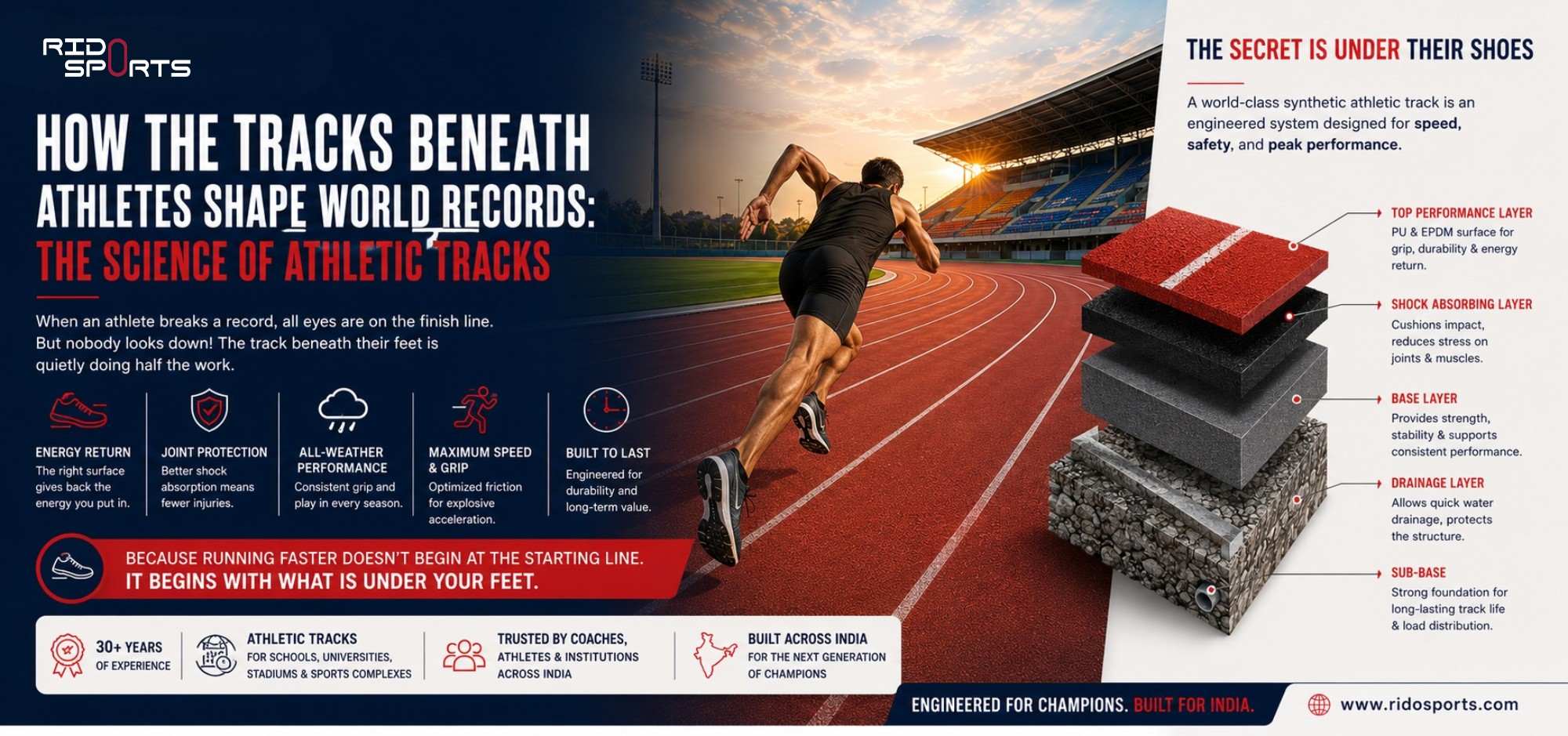
A synthetic track looks simple, one flat surface, a few white lines. But beneath it? An entire engineered system working in silence.
There's a base layer for structural strength and drainage. A shock-absorbing middle layer to protect the body. And a top performance layer, made from polyurethane and EPDM granules, that grips your shoe and returns energy back into every stride.
Why Full PUR Is the Gold Standard
If you've ever wondered why elite stadiums around the world choose Full PUR athletic track systems, the answer is simple: they last longer, perform better, and take care of athletes at the highest level.
Ridoflex Full PUR, engineered to meet World Athletics (WA) and IAAF certified standards, absorbs shock brilliantly, holds up across seasons, and delivers consistent performance year after year. For any serious facility, Full PUR is the main benchmark.
Fast Tracks Also Keep Athletes Safe
Speed matters. But staying injury-free matters more. Shin splints, stress fractures, joint pain, poor track surfaces quietly contribute to all of them.
A professionally installed IAAF certified running track removes a lot of that risk. Athletes get a predictable, stable surface built for the way the human body actually moves. Coaches and institutions get peace of mind knowing their athletes are protected from the ground up.
One Track Doesn't Fit All
A school athletics programme has different needs than an Olympic training centre, and that's completely fine. A Sandwich System or Spray-On Track can deliver strong performance at a budget that works for smaller institutions, while still meeting the demands of competitive sport.
The key is matching the right system to the right facility, based on usage, climate, competition level, and long-term goals. Whether it's a track for a university or an activity track for a residential society, choosing the right one can make all the difference to performance, safety, and longevity.
India Is Building Something Big
India's appetite for world-class sports is growing fast. Schools, universities, defence academies, government projects, everyone is investing in sports infrastructure that can produce the next generation of champions.
At Rido Sports (Desan International), we have been part of that journey for over three decades. As a trusted sports infrastructure company in India — WA, ITF, BWF, and EN certified — we have helped lay the foundation, quite literally, for athletes across the country. Across schools, universities, stadiums, and sports complexes throughout India, Rido Sports build the high-performance surfaces where future champions begin their journey.
The Finish Line Starts at the Ground
Next time you watch a sprinter explode off the blocks or a distance runner find their rhythm, take a second to look down. That surface beneath them is not passive. It's working.
Because running faster does not begin at the starting line. It begins with what is under your feet.